 Rahul Somvanshi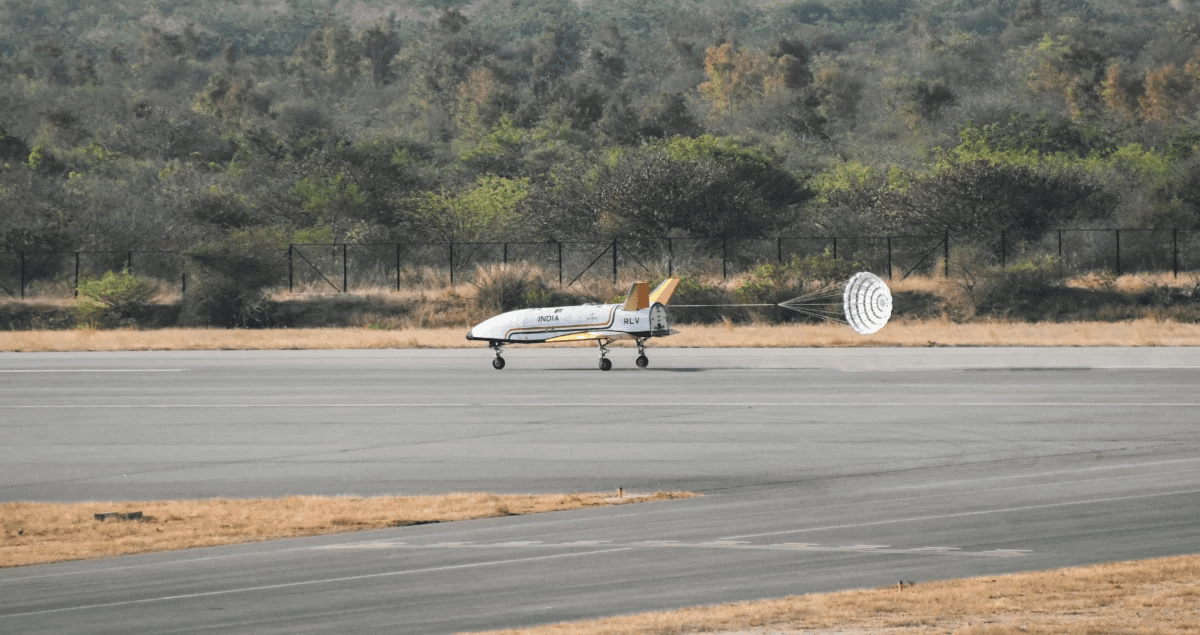
On Sunday, the Indian Space Research Organisation (ISRO) successfully launched and landed a reusable launch vehicle. The Reusable Launch Vehicle Autonomous Landing Experiment (RLV LEX) test mission was dropped from a helicopter and later managed to land safely using its wheels. The test was conducted at the Aeronautical Test Range (ATR) in Chitradurga, Karnataka, from 7.10 am to 7.40 am on April 2, 2023.
The RLV-LEX was transported by a Chinook helicopter by the Indian Air Force, and the landing was executed horizontally. The RLV LEX, is classified as a space plane and looks a lot like the US’s Space Shuttle and Russia’s Buran reusable vehicle.
The spacecraft was carried by a Chinook helicopter and was brought to an altitude of 4.6 kilometres (2.85 miles) before being dropped mid-air. Along with ISRO and the Air Force, several other entities contributed to this test. The RLV made use of many of ISRO’s cutting-edge technologies, including domestically developed landing gear, aerofoil honeycomb fins, a braking parachute system, a pseudolite (pseudo-satellite) system, and India’s own satellite navigation system, Navigation with Indian Constellation, or NavIC.
RLV LEX is at an initial experimental stage and has yet to reach orbit. In a 2016 test, the vehicle was released at an altitude of 65km (40.3 miles) and successfully demonstrated hypersonic flight capabilities. ISRO expects that the vehicle will one day launch payloads into orbit for just $4,000/kg. The development of a functional, reusable launch vehicle (RLV) will manage to bring down costs significantly.
- Canada Targets Double Grid Capacity by 2050 as Electricity Demand Puts Transmission Projects Under Pressure
- Jennifer Eckhart, Former Fox Business Producer, Dies at 36
- Florida’s Permanent Daylight Saving Time Push Cannot Stop the November 1 Clock Change
- Carnival Cruise Passenger Missing After Going Overboard Off Mexico Coast
- Tesla Roadster Reservations Reportedly Reopen Ahead of October 1 Event Without Confirmed Production Details